REVIEW · AMMAN
Full Day Jerusalem & Bethlehem Private Guided Tour From Amman
Book on Viator →Operated by Petra Limo · Bookable on Viator
Jerusalem and Bethlehem feel close on this full-day run. I like how the route is built around the big sights without wasting your time, with private transport and an English-speaking driver doing the hard logistics. You get real face-time with places like the Mount of Olives viewpoints and the Church of the Holy Sepulchre, plus the Bethlehem highlight at the Church of the Nativity.
One thing to plan for: costs and timing can add up. Entrance fees and border-related items aren’t included, and Temple Mount in particular requires extra attention to rules, hours, and security flow once you’re there.
In This Review
- Key highlights to know before you go
- A private Amman-to-Jerusalem day that trades stress for time
- Mount of Olives: views, cemeteries, and the Church of the Ascension (1910)
- Temple Mount: Dome of the Rock plaza plus shared meaning (and real rules)
- Church of the Holy Sepulchre: Calvary tradition and Stations of the Cross in one place
- Via Dolorosa: how to follow the stations without getting lost
- Tower of David: your “break” stop that turns into Jerusalem context
- Mount Zion: Last Supper Room, Dormition, and the Peter denial connection
- Old City ramparts: choosing your walk from Jaffa Gate to Lion’s Gate or Dung Gate
- Bethlehem’s Church of the Nativity: underground grotto and a tight visit window
- Price, value, and what to budget beyond the $644.99
- Is it safe and easy? The real-world mindset that helps
- Who this Jerusalem & Bethlehem private guided tour suits best
- Should you book this private day from Amman?
- FAQ
- How long is the Jerusalem and Bethlehem private guided tour?
- Do you offer pickup from Amman?
- Is this tour private or shared?
- Is an English-speaking driver included?
- Are entrance fees included for sites like Temple Mount and the Church of the Holy Sepulchre?
- Is bottled water provided?
- Is the border shuttle bus included?
- Do I need to pay visa and departure taxes separately?
- Can I cancel and get a refund?
Key highlights to know before you go
- Mount of Olives panoramas plus classic church stops including the Church of the Ascension (dating to 1910)
- Temple Mount in one hour at the Dome of the Rock plaza with shared significance for Jews, Muslims, and Christians
- Holy Sepulchre as the Via Dolorosa finale where last Stations of the Cross are inside the church
- Via Dolorosa directions that actually help so you don’t lose the stations from 1 to 14
- Tower of David museum stop that turns a quick viewpoint pause into a Jerusalem story lesson
- Bethlehem’s Nativity focus with the underground grotto marking the traditional birthplace site
A private Amman-to-Jerusalem day that trades stress for time
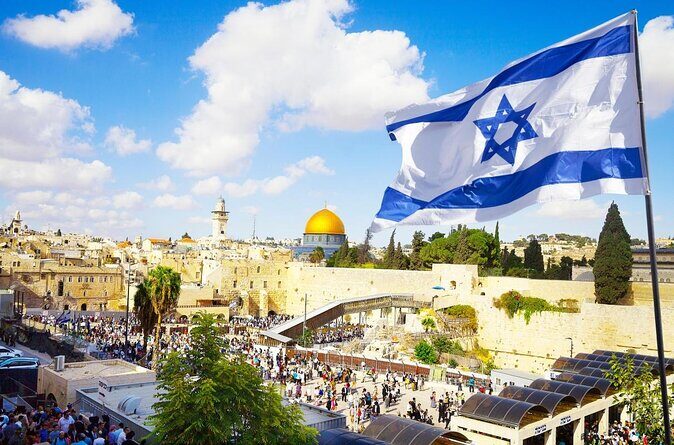
This is a long day on purpose. You’re looking at an 11–12 hour stretch that compresses Jerusalem’s core holy sites and then carries you about 10 km (6.2 miles) south to Bethlehem. If you’ve ever tried to do this under your own steam—sorting transport, timing, and route flow inside the Old City—then you’ll understand why a private setup is such a big value here.
I also like that the tour starts with practical comfort: an air-conditioned vehicle, bottled water, and parking fees handled. You’re not left guessing how you’ll get from one sacred stop to the next, especially when driving into and around the Old City can feel like a maze to first-timers.
The other “quiet win” is flexibility. It’s only your group, so you can move at a more human pace rather than getting swept along by a big bus crowd. And if you choose the guided option, you’ll have an escorted guide at the sites, which matters when the places are crowded and rules change depending on the day and time.
You can also read our reviews of more guided tours in Amman

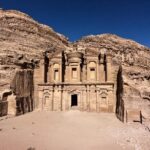
Mount of Olives: views, cemeteries, and the Church of the Ascension (1910)
Most days in Jerusalem start with the view, and this one does it right. You head to the Mount of Olives, a sacred hill packed with churches and home to the oldest continually used cemetery in the world. Even if you’re not chasing religious details, the peak gives you something you can’t fake: a broad look over the Old City.
For Christian visitors, the mount is strongly tied to the belief that this is where the resurrection and the ascent story connect. That context isn’t just trivia when you’re standing there. It changes how you read the terrain: you start seeing Jerusalem not as a map pin but as a layered set of meanings.
A top stop here is the Church of the Ascension, dated to 1910, and described as having the best views across Jerusalem. As you walk down, you’ll also come across the Church of the Pater Noster, built next to the traditional site where Jesus instructed his disciples.
Practical note: expect some walking down from the viewpoints. Comfortable shoes help, and if your day is already tight, take a minute at the top first. Get your bearings fast, then let the descent do the rest of the sightseeing work.
Temple Mount: Dome of the Rock plaza plus shared meaning (and real rules)
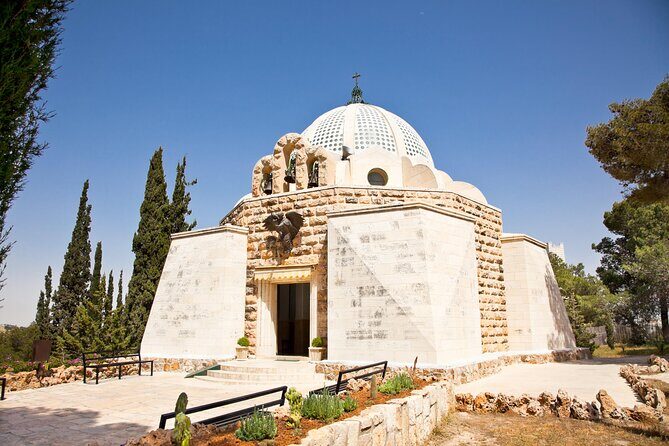
Temple Mount, also known by the name Haram al-Sharif, is one of those places where history and present-day sensitivity are part of the experience. It’s significant for Jews, Muslims, and also recognized in broader Abrahamic tradition—Abraham’s story, Solomon’s First Temple connection, and Muhammad’s early ascent narrative all get referenced here.
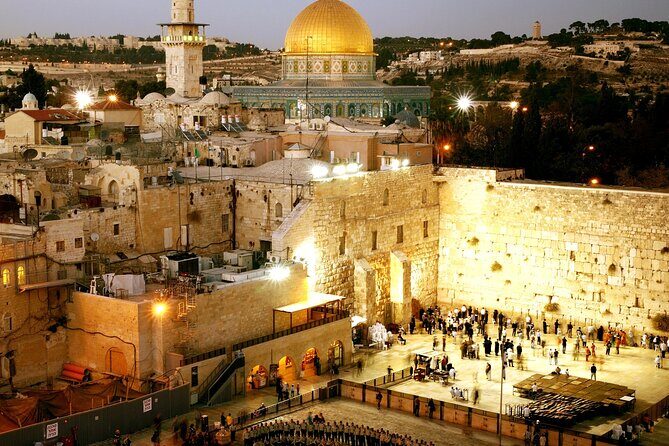
The visual centerpiece is the plaza area dominated by the Dome of the Rock, one of Jerusalem’s most iconic landmarks. Under the golden dome, there’s a sacred stone that both Jews and Muslims believe to be connected to Abraham’s sacrifice story. Standing in that space, you feel why this site is both meaningful and contentious.
The tour gives you about an hour here. That’s long enough to see the main plaza and get oriented, but not enough to treat Temple Mount like a slow museum day. If you’re the type who likes to read every sign and photograph every angle, you may feel rushed. If you’re there to understand the major features and move on, that one-hour structure is a good fit.
What I’d plan for: you’ll want to dress and behave with extra care, because this is a sanctuary with deep importance for multiple faiths. If you’re uncertain about expectations, it helps to let the guide’s instructions be your rulebook so you don’t guess wrong.
Church of the Holy Sepulchre: Calvary tradition and Stations of the Cross in one place
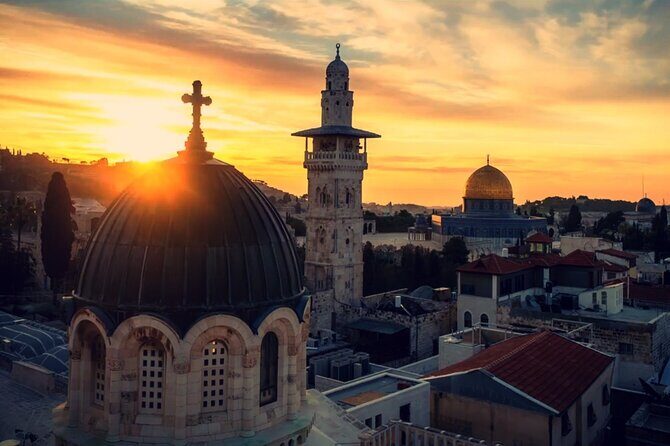
After Temple Mount, you go into the Christian core. The Church of the Holy Sepulchre is presented as Jerusalem’s holiest Christian site and is believed to be built on the location of Jesus’ crucifixion.
Here’s what makes this stop more than just a big church interior. The site is tied to the story of Saint Helena and Constantine, with the claim that Helena announced the Calvary location to the Byzantine world. The church you see today traces to a grand rebuilding in the 11th century, after earlier structures were destroyed centuries earlier (the original church is dated to 335 CE, and destruction is noted in 1009).
Inside, the church is described as opulently beautiful and built for pilgrimage traffic. That can mean it’s crowded. But even when it’s busy, it’s still one of those places where the structure itself helps you follow the timeline—especially because it serves as the ending point for the Via Dolorosa pilgrimage.
Key detail for your mental map: the last five Stations of the Cross are within the Church of the Holy Sepulchre. That means when you arrive, you’re not just stepping into a chapel; you’re reaching the end of a route you’ll likely have been following in your mind as you walk the streets.
Via Dolorosa: how to follow the stations without getting lost
The Via Dolorosa is often the highlight for Christian visitors because it follows the route of Jesus Christ after condemnation, bearing the cross toward execution at Calvary. And unlike “look, it’s a street” sightseeing, this is a walk you can actually track.
The tour’s structure helps you avoid the common problem: confusion about where station 1 starts and how you connect the blocks. The walk begins on Via Dolorosa Street at the 1st station, east of the intersection with Al-Wad Street. Then you proceed west, continue south onto Al-Wad Street, and loop back west onto Via Dolorosa Street again. The description also notes the walk continues through eight stations, reaching the 9th station at the Church of the Holy Sepulchre, where the last five stations continue inside.
If you’re coming on a Friday, there’s an added living detail: you can join a procession along this route led by Italian Franciscan monks. That can make the walk feel less like sightseeing and more like a ritual that’s still ongoing.
If crowds are intense, take the route in pieces. Don’t force it all in one go with constant stopping and starting. If you want the meaning, pause at the stations. If you want the photos, keep your pace steady and save deeper moments for the final stretch by the Holy Sepulchre.
You can also read our reviews of more private tours in Amman




Tower of David: your “break” stop that turns into Jerusalem context
Right after the Via Dolorosa, you shift from street theology to a hilltop city story. The tour includes the Tower of David, also called the Citadel, though the name can confuse people—there’s no direct link to David. The tower area was erected by King Herod around 24 BCE to protect his palace.
The historical timeline here is a handy way to reset your brain. After Titus’ conquest in 70 CE, Romans stationed a garrison. Later the citadel fell into disrepair and was rebuilt by Crusaders, Mamelukes, and the Ottomans. That layered rebuild is part of what makes Jerusalem feel like one city sitting on multiple cities.
The current building was built in the 14th century on the foundations of the earlier Phasael Tower. Inside, the Tower of David Museum relays the story of Jerusalem and includes a permanent display of archaeological exhibits.
You get about an hour here. That’s a sweet spot if you want to cool your feet after walking and also make the rest of the day click. It helps you see the Old City as a set of eras, not a single snapshot.
Mount Zion: Last Supper Room, Dormition, and the Peter denial connection
Mount Zion sits just south of the Old City’s Zion Gate and it’s a hub of Jewish and Muslim shrines with church connections too. The tour uses this stop to connect multiple traditions.
For some Christian tradition, Mount Zion is where Christ celebrated the Last Supper and where the Virgin Mary spent her final years. Another tradition places Mary’s later life in Ephesus, so the site carries that sense of competing narratives.
For Jews, the importance is tied to the Tomb of King David. From the tomb’s courtyard, you can climb stairs to reach the Last Supper Room. The description notes that this room has served as both church and mosque over time.
Nearby, the Church of the Dormition is referenced as where Mary is supposed to have died, and just to the east is the Church of St. Peter of Gallicantu, tied to the story of Peter’s denial of Jesus.
This is the kind of stop where time feels important. You get roughly an hour, which means you’ll likely see the main sites without going on a full photo-and-read marathon. If you’re here for religious meaning, this time window works well. If you’re here for deep architecture study, you might want extra time elsewhere.
Old City ramparts: choosing your walk from Jaffa Gate to Lion’s Gate or Dung Gate
After Mount Zion, you shift into Old City fortifications. The Old City walls date from the Ottoman period, and there are nine major gates that connect to the neighborhoods within.
You’ll pass by named gates including Damascus Gate (well-known), Lion’s Gate (sometimes called St. Stephen’s Gate), Zion Gate (entry into the Jewish Quarter), and Jaffa Gate (main passageway for the Christian Quarter). Even if you never step deep into every quarter, seeing the gates while you’re oriented helps you understand how the Old City is segmented.
One of the best “use your time well” moments is walking the wall ramparts. You get two possible sections: Jaffa Gate heading north to Lion’s Gate, or Jaffa Gate heading south to Dung Gate. A wall walk is one of the few ways to see the city rhythm without getting stuck in narrow street crowds.
I’d pick the section based on your energy. If you want more classic Old City skyline views, go north to Lion’s Gate. If you want a more southward taste, choose the Dung Gate direction. Either way, you’ll finish with a clearer mental map.
Bethlehem’s Church of the Nativity: underground grotto and a tight visit window
Then you go south to Bethlehem. The drive is short enough to make it feel doable, and the city is about 10 km (6.2 miles) from Jerusalem. Bethlehem means House of Bread, which is a nice reminder that the place is not only about one calendar event.
Your highlight is the Church of the Nativity, tied to the traditional birthplace of Jesus. The tour description specifically notes the exact place is marked in an underground grotto—this is the moment most people picture when they imagine Bethlehem.
Christmas season is also described as a peak time for pilgrims from around the world to make this visit. Even outside peak days, this church tends to draw people, so expect a pilgrimage atmosphere rather than quiet tourism.
The stop also frames Bethlehem with other points of interest: Rachel’s Tomb is at the northern entrance of Bethlehem and is an important Jewish holy site, and the Old Testament identifies Bethlehem as David’s city and the place connected to his first kingship.
You’ll have about two hours in Bethlehem, which is realistic. It’s enough time to reach the Nativity church highlight, see key surrounding context, and still get back on schedule without feeling like you’re sprinting every minute.
Price, value, and what to budget beyond the $644.99
At $644.99 per person, this isn’t a budget trip. But it’s also not just a car rental with a loose plan. You’re paying for private transportation, a longer-than-average full-day structure, and an English-speaking driver who can handle the flow between major areas.
You also get:
- air-conditioned vehicle
- bottled water
- parking fees
- private transportation
- pickup offered
The part that can surprise you: entrance fees and border-related items aren’t included. Temple Mount and the Holy Sepulchre are listed as not included. Tower of David, Mount Zion sites, and other entrance items are also not included. Also, the shuttle bus at the border between immigration (Jordan and Israel) is not included, and visa and departure taxes aren’t included either.
Then there’s tipping: tips for the driver and guide aren’t included. If you choose the guided option, you’ll likely want to factor in a tip as part of being fair for the day’s work.
Bottom line: this tour tends to be best value when you want stress-free logistics and don’t want to negotiate transport, routing, and site transitions on your own. If you already have your own plan and you’re comfortable figuring out entrance costs, the price may feel steep. If you want the smooth version of this day, the private format starts to make sense.
Is it safe and easy? The real-world mindset that helps
One of the big reasons people feel good about booking this type of day trip from Amman is that it removes the “what do we do next?” problem. You can be the person who simply follows the plan: get in the air-conditioned vehicle, reach each major site, and have the timing handled between stops.
That doesn’t mean you’ll avoid crowds. Places like the Church of the Holy Sepulchre and busy holy routes can be packed. What it does mean is you won’t have to guess your way through transitions.
If the political news in the region has made you nervous, I’ll say this plainly: having an operator like Petra Limo manage the day’s moving pieces can make a huge difference. You still have to be sensible once you’re there, but you’re not doing the hardest part on your own.
Who this Jerusalem & Bethlehem private guided tour suits best
This is a good fit if:
- you want one-day coverage of Mount of Olives, Temple Mount, Holy Sepulchre, Via Dolorosa, and Bethlehem
- you prefer private transport and minimal friction
- you like having help interpreting what you’re seeing, especially if you choose the escorted guide option
- you’re traveling with people who don’t want to navigate on their own in the Old City
It might be less ideal if:
- you’re on a strict budget once you add entrance fees and border items
- you hate long days (this is 11–12 hours)
- you’re hoping for a slow, optional wandering style with no schedule pressure
Should you book this private day from Amman?
I’d book it if you want the classic Jerusalem-and-Bethlehem hits in one day and you’d rather pay for smooth logistics than spend your energy figuring out how to make it work. The route is built around the major sacred landmarks, and the private format plus water, pickup, and parking handled makes the day feel manageable.
I’d think twice if you don’t want to handle extra costs for entrances and border-related items, or if you’re sensitive to long days with lots of movement and crowds. If you go in with realistic expectations, this trip can be one of those “I’m glad we did the hard part” travel days.
FAQ
How long is the Jerusalem and Bethlehem private guided tour?
It runs about 11 to 12 hours.
Do you offer pickup from Amman?
Yes, pickup is offered.
Is this tour private or shared?
It’s private, and only your group participates.
Is an English-speaking driver included?
Yes, an English-speaking driver is included.
Are entrance fees included for sites like Temple Mount and the Church of the Holy Sepulchre?
No. Entrance fees are not included, and the tour lists tickets as not included for Temple Mount and the Church of the Holy Sepulchre.
Is bottled water provided?
Yes, bottled water is included.
Is the border shuttle bus included?
No. The shuttle bus at the border between immigration (Jordan and Israel) is not included.
Do I need to pay visa and departure taxes separately?
Yes. Visa and departure taxes are not included.
Can I cancel and get a refund?
No. The experience is non-refundable and cannot be changed for any reason.