REVIEW · AMMAN
Trip to Jerash, Ajloun and Umm Qais
Book on Viator →Operated by Monte Carlo Rent A Car · Bookable on Viator
Three ancient sites, one smooth day from Amman. This private tour runs from 8:00 am and strings together Jerash’s Roman streets, Ajloun Castle, and the viewpoint-heavy ruins at Umm Qais—so you get a lot of variety without babysitting logistics.
I especially like the way Jerash gets a full five hours, not a rushed slap-on photo stop. You can move from Hadrian’s Arch to the Oval Plaza, then the Temple of Artemis, the South Theatre, Nymphaeum, the Colonnaded Street, and the Temple of Zeus—plus both the Byzantine Church and the North Theatre, ending at the Jerash Archaeological Museum.
One thing to plan for: entrance fees are not included, and the driver is not a site guide inside the ruins. If you want deeper explanations on the spot, you’ll need to ask for a guide at the entrances.
In This Review
- Key highlights at a glance
- Jerash’s Colonnaded Streets: Hadrian’s Arch, Artemis Temple, and Two Theatres
- Timing That Actually Works: Five Hours in Jerash, Two in Ajloun, One in Umm Qais
- Ajloun Castle at Qala’at ar-Rabad: Panoramas and Crusades-Era Fort Facts
- Umm Qais (Gadara): Roman Theater, Byzantine Church, Viewpoint, and Black Basalt
- Private Tour Comfort: Pickup, Wi‑Fi, and Drivers Like Bassam, Aneese, and Haroun
- Price and Value for a Group of Up to 4
- Should You Book This Jerash–Ajloun–Umm Qais Tour?
- FAQ
- What time does the tour start?
- How long is the experience?
- Is this a private tour?
- What’s the group size limit?
- Are entrance fees included?
- Is pickup offered?
- Does the driver also act as a guide at the sites?
- What if the weather is bad or I need to cancel?
Key highlights at a glance
- Jerash for five hours covers the main Roman walk—arches, temples, theaters, plus the archaeological museum
- Ajloun Castle (Qala’at ar-Rabad) gives you that Crusades-era fortress feeling and big panoramic views
- Umm Qais (Gadara) mixes Roman and Byzantine remains with Ottoman-era buildings and black basalt structures
- Private group size up to 4 keeps the day flexible for families or small groups
- Wi‑Fi in the vehicle and mobile ticket help you stay oriented and reduce admin stress
Jerash’s Colonnaded Streets: Hadrian’s Arch, Artemis Temple, and Two Theatres

Jerash is the reason a lot of people pick this day trip, because it’s the most complete Roman-city experience in one sitting. You’re not just ticking off a single landmark. You’re walking a sequence of major stops—each with its own vibe.
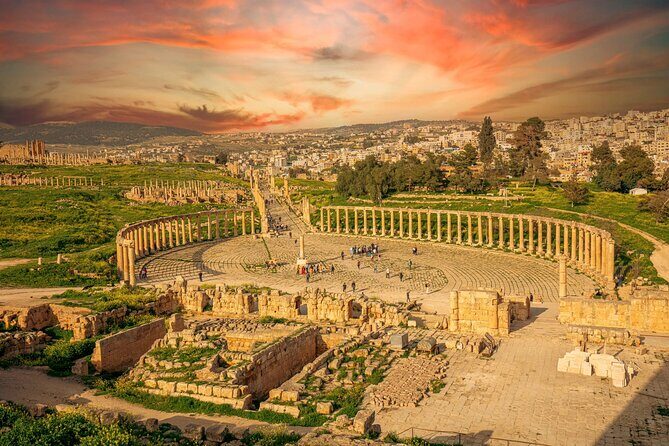
The day starts in Jerash with Hadrian’s Arch, an obvious first landmark that helps you understand the layout. From there, you move into the Oval Plaza, which is a good place to slow down and get your bearings before you start climbing deeper into the ruins.
Then comes the centerpiece for many history lovers: the Temple of Artemis. Even if you’re not a textbook person, the scale and attention to detail make it feel like a moment you’re supposed to linger over. You also see the Colonnaded Street, which is the “Roman postcard” view people hope for—long, rhythmic, and easy to visualize as the city’s main spine.
You’ll also want to look for the theaters, because Jerash gives you more than one. The South Theatre is one of the standout features of the complex, and the North Theatre adds a second perspective. If you like seeing how ancient spaces were designed for crowds, this double set of theaters helps you make sense of how the city functioned.
A couple of other stops are worth your attention because they add variety beyond big monuments. The Nymphaeum tends to catch people’s eye as a quieter, decorative stop. The Temple of Zeus gives you another temple encounter, and the Byzantine Church adds a later layer to the story of the site.
Finally, Jerash doesn’t end with ruins. You’ll also have time at the Jerash Archaeological Museum. That’s a smart way to close the loop, because museum time helps you connect what you saw outside with artifacts and context you might otherwise miss.
Practical tip: Jerash is a lot of walking on uneven stone. I’d show up with supportive shoes and plan for sun and shade changes as you move between open plazas and covered or partially shaded areas.
You can also read our reviews of more tours and experiences in Amman.

Timing That Actually Works: Five Hours in Jerash, Two in Ajloun, One in Umm Qais
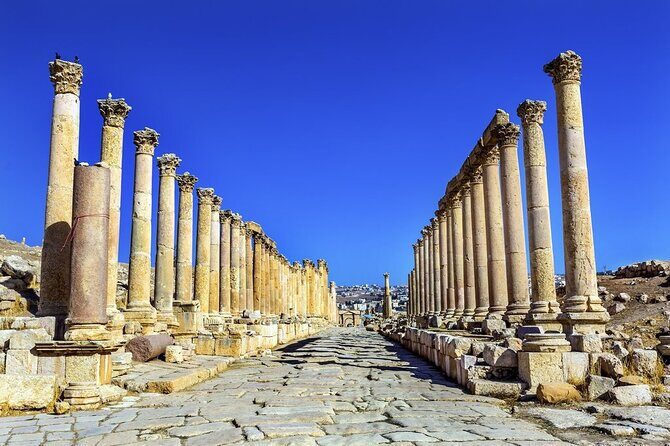
This tour is built around a simple rhythm: Jerash first, then Ajloun Castle, and then Umm Qais. That order matters. Jerash is the most time-intensive stop, and it gets five hours, which is enough to see the main cluster of sites without feeling like you’re constantly sprinting for the next photo.
Ajloun is shorter but still substantial. You’ll have about two hours at Ajloun Castle (Qala’at ar-Rabad). That’s a good match for a fortress visit where part of the experience is slow wandering and part is taking in views.
Then Umm Qais comes in last with about one hour at the ruins and viewpoint area. One hour sounds short until you realize Umm Qais is a compact mix: Gadara Ruins, the Roman Theater, a Byzantine Church, the Colonnaded Street, plus the Archaeological Museum and the Viewpoint. There are also Ottoman-era buildings and Black Basalt structures, so you’re not only looking for one monument—you’re sampling the different layers in the same area.
The whole day runs 8 to 12 hours in total, and that range is usually what makes or breaks a day trip. If you like structure, the scheduled stop durations help. If you hate feeling rushed, the fact that Jerash is given the majority of time helps keep the day feeling human.
Ajloun Castle at Qala’at ar-Rabad: Panoramas and Crusades-Era Fort Facts
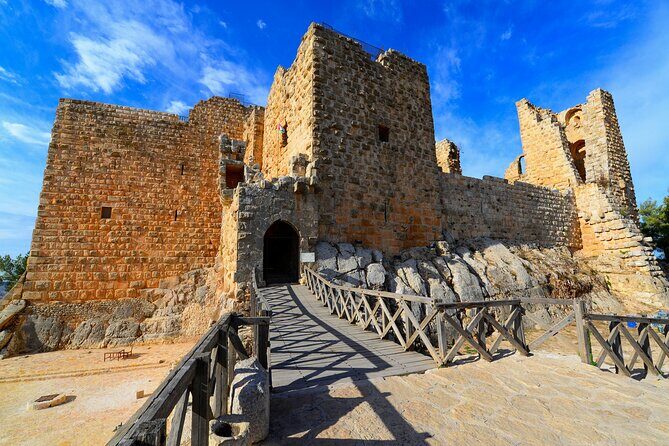
Ajloun Castle is where the vibe shifts. Jerash feels open and urban—streets, plazas, theaters. Ajloun is a 12th-century fortress, and it comes with the practical payoff of views.
You’ll go directly to Ajloun Castle (Qala’at ar-Rabad) for around two hours. The big draw here is that the castle gives you panoramic outlooks over the surrounding area. That matters because it changes how you read the walls and towers. You’re not just looking at a building. You’re imagining why someone would build it there.
The tour description also points to Ajloun’s historical significance during the Crusades. Even without overcomplicating it, that theme helps frame what you’re seeing: a defensible site, built for control and observation, not comfort.
This stop also works well for people who sometimes get bored by nonstop Roman columns. A fortress changes your pace. You can take your time. You can look, step back, look again, and connect the view to the purpose of the place.
Practical tip: fortress stone can feel warmer than you expect in sun and cooler in shade. Bring something light you can add or remove as you move around.
Umm Qais (Gadara): Roman Theater, Byzantine Church, Viewpoint, and Black Basalt
Umm Qais is the “layers and scenery” stop. You’re visiting the ancient city of Gadara, and the mix of remains is what makes it satisfying—even when the visit is only about an hour.
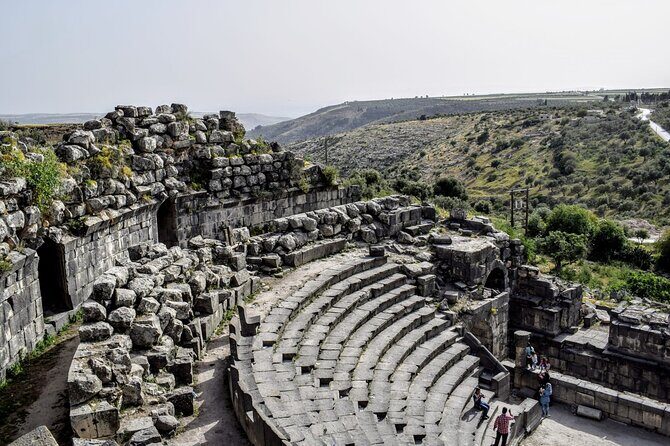
You start at the Gadara Ruins, which sets the stage. Then the Roman Theater gives you another angle on how the region’s Roman-era public spaces looked and sat in the site.
After that, you’ll see a Byzantine Church and additional elements like the Colonnaded Street. That’s a helpful contrast with Jerash. Jerash is heavily Roman with later touches. Umm Qais feels like a site where you’re constantly aware of different time periods living on top of each other.
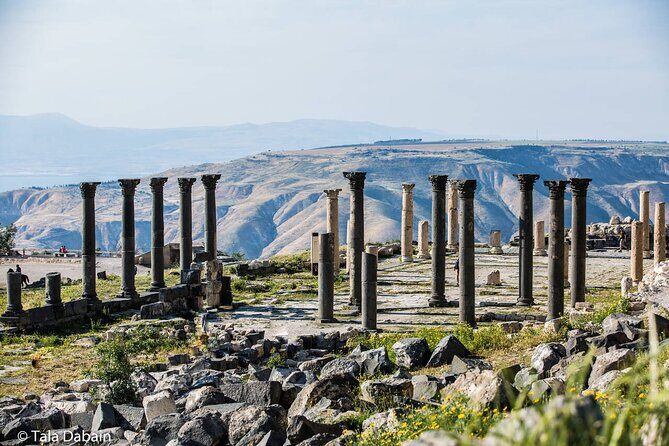
Then there’s the viewpoint. The Viewpoint stop is where the tour earns its name as a “ruins plus nature” day. You’re looking out toward the Golan Heights and the Sea of Galilee area, which is exactly the kind of sight that makes history feel three-dimensional instead of distant.
Umm Qais also includes elements that feel different from typical ruin days: Ottoman-era buildings, Black Basalt structures, and the farmland views (the agrarian scenery). Those black basalt features are especially memorable because they add texture to what you’re looking at. It’s not just pale stone and broken columns.
If you want the highest return on your limited time at Umm Qais, don’t treat it like a single sweep. Do one slow pass through the ruins, then reset at the viewpoint and look back at the site from that perspective.
Private Tour Comfort: Pickup, Wi‑Fi, and Drivers Like Bassam, Aneese, and Haroun
The biggest “comfort” value here isn’t a luxury feature—it’s the way the day runs smoothly. This is a private tour for your group only, sized up to 4 people, which tends to make the timing feel less chaotic.
Pickup is offered, and that’s a big deal for a morning start. Reviews also underline that drivers are consistently on time and easy to work with, including names like Bassam, Aneese, and Haroun. The common theme is friendly, helpful, and flexible—so if your group is slower, you’re not punished with an impossible schedule.
Communication also seems to be a strong point. Multiple reviews mention messaging by WhatsApp, which is useful when you’re trying to coordinate meeting points in a city like Amman without stress.
Inside the vehicle, you get free Wi‑Fi / internet connection. That sounds small until you’re using it to map routes, check timing, or quickly look up what you’re standing in front of while you’re still there.
One important nuance: the driver is not the guide inside the sites. If you want more explanation than what you can read on your own, you’ll need to ask for a guide at the entrance. In practice, that means you control your level of depth. You’re not forced into a lecture, but you also have a path to extra details.

Price and Value for a Group of Up to 4
At $230 per group (up to 4), this tour is priced like a “small group” day, not a mass-market bus outing. The value depends on how many people you split it with.
- If you go as a full group of 4, the cost is about $57.50 per person. That’s a very workable number for a day that includes Jerash plus two more major sites.
- If it’s only 2 people, you’re closer to $115 per person. Still reasonable given the distances and the private format, but it’s worth knowing you’ll feel the price more.
What’s not included: entrance fees. So your real total cost is the tour price plus site admissions paid directly at the locations. For budgeting, I treat those as the unavoidable add-on that I can’t negotiate, but I can plan for.
Booking pace is also worth noting: this is commonly booked about 8 days in advance on average. That’s a hint that if you’re traveling in a busy window, you should plan earlier rather than later.
If you’re the kind of traveler who hates waiting around, the private format pays off. You’re not stuck with a crowd tempo. Your driver helps keep the day moving on a plan that fits the stop durations.
Should You Book This Jerash–Ajloun–Umm Qais Tour?
I’d book it if you want one efficient day that hits the three big targets: Roman Jerash, the fortress views of Ajloun, and the layered ruins and scenery at Umm Qais. The stop balance makes sense—Jerash gets the time, Ajloun adds a fortress break, and Umm Qais caps the day with viewpoint energy.
Skip it—or at least reconsider—if you know you need guided, deep commentary at every site. Since the driver is not acting as the site guide inside the locations, you’ll have to handle extra explanations by asking for a guide at entrances.
If you’re flexible, walk at your own pace, and enjoy piecing together what you’re seeing, this is a strong value day trip from Amman.
FAQ
What time does the tour start?
The tour starts at 8:00 am.
How long is the experience?
It runs about 8 to 12 hours in total.
Is this a private tour?
Yes. It’s a private tour/activity, and only your group participates.
What’s the group size limit?
The tour price is per group up to 4 people.
Are entrance fees included?
No. Entrance fees are not included and must be paid directly on-site.
Is pickup offered?
Yes, pickup is offered.
Does the driver also act as a guide at the sites?
The driver is not the guide in the locations. If you need a guide, you can ask for one at the entrance.
What if the weather is bad or I need to cancel?
This experience requires good weather. If it’s canceled due to poor weather, you’ll be offered a different date or a full refund. You can cancel up to 24 hours in advance for a full refund.