REVIEW · AMMAN
Private Tour: Full Day Trip of Jerash, Umm Qais, and Pella from Amman
Book on Viator →Operated by Zaid Tours and Travel · Bookable on Viator
Three Roman worlds in one long day. This private full-day route strings together Jerash, Umm Qais, and Pella with hotel pickup and drop-off, plus included site time so you are not stuck hunting logistics.
What I like most is that Jerash comes with a proper local guide (not just a driver pointing at stones), so you get the big story behind Hadrian’s Arch, the Oval Plaza, and the colonnaded street. I also like the day plan’s rhythm: you get a guided start at Jerash, then slower self-exploration time at Umm Qais, and finally a lighter, more free-form stop at Pella.
One consideration: Pella may feel like the wild card. It has no local guides included, and if the site is closed or limited on the day, you could end up with less of what you came for.
In This Review
- Quick hits to know before you go
- Why three sites in one day actually works
- Jerash: Hadrian’s Arch to the Oval Plaza with a real local guide
- The showpieces you’ll spend time on
- The practical upside of guided time
- Umm Qais (Gadara): hillside ruins, Ottoman village remnants, and a museum you’ll like
- The views are part of the value
- What you’ll actually visit at Umm Qais
- One note about guides here
- Pella: the 8,000-year layers stop, with less structure than Jerash
- What you’ll see (and what you might miss)
- The real-world risk
- The drive, the pacing, and how to avoid a sunburned brain
- Price and value: what $160 covers (and what you should budget for)
- Who this tour fits best
- Should you book the Jerash, Umm Qais, and Pella private trip?
- FAQ
- What time does the tour start?
- How long does the full-day trip take?
- Do I get hotel pickup and drop-off in Amman?
- Is this a private tour?
- Are entrance fees included?
- Do I get a local guide for all three sites?
- Are meals included?
- What languages are available for the tour?
- Is Wi‑Fi provided?
- What if the weather is bad or I need to cancel?
Quick hits to know before you go
- Private hotel pickup and drop-off in Amman means you start the day already settled, not stressed.
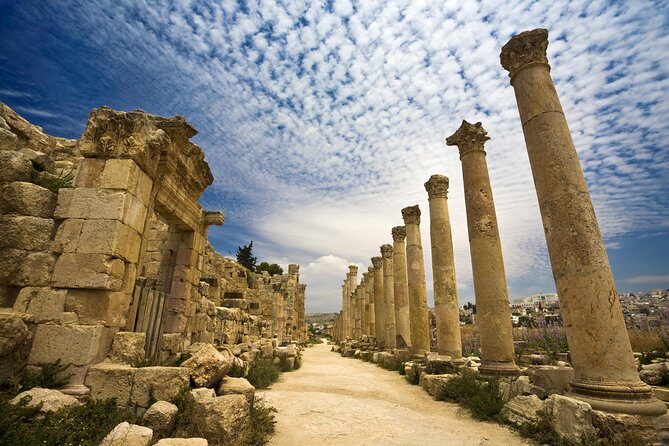
- Guided Jerash is the anchor, with a local English-speaking guide and all the main showpieces like Hadrian’s Arch and the Oval Plaza.
- Umm Qais includes the museum in a restored Ottoman governor’s palace, plus big views over the Jordan Valley, Sea of Galilee, and Golan Heights.
- Pella is self-guided in practice since no local guides are included, so it works best if you like wandering and reading your way through ruins.
- Entrance fees are covered for Jerash and Pella ruins, and for Umm Qais plus its museum (unless you handle it via a Jordan Pass arrangement).
- On-board Wi‑Fi helps when you want to look up maps, photos, or details between stops.
Why three sites in one day actually works
This tour is built for people who want to see Jordan’s top Roman-era sites without turning the trip into an all-day puzzle. Jerash alone can take real time, and then you add Umm Qais and Pella. The payoff is a day that shows how the Roman world worked at the empire’s frontier: city planning, public buildings, and the way later eras reused the same spots.
You also get two different flavors of ruins. Jerash feels like a complete Roman city with big public architecture and strong visual clarity. Umm Qais and Pella are more about layers—Greco-Roman remains on a hillside, then older Hellenistic roots beneath later Roman development. That contrast is the point. It keeps the day from feeling like three versions of the same photo.
You can also read our reviews of more private tours in Amman

Jerash: Hadrian’s Arch to the Oval Plaza with a real local guide
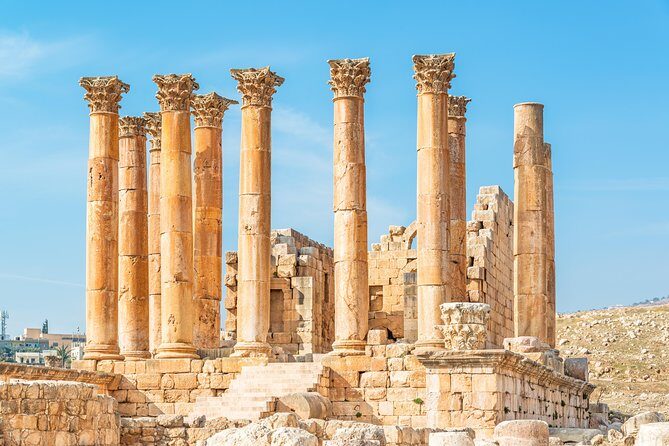
Jerash is the star of the route, and the structure of the day reflects that. You enter through the main gateway, Hadrian’s Arch, then meet your local guide right at the site so you are not trying to decode everything on your own.
From there, you focus on the big civic spine of Jerash: plazas and streets, plus the religious and entertainment pieces that tell you who lived here and how the city functioned.
The showpieces you’ll spend time on
You’ll walk past and talk through highlight areas such as:
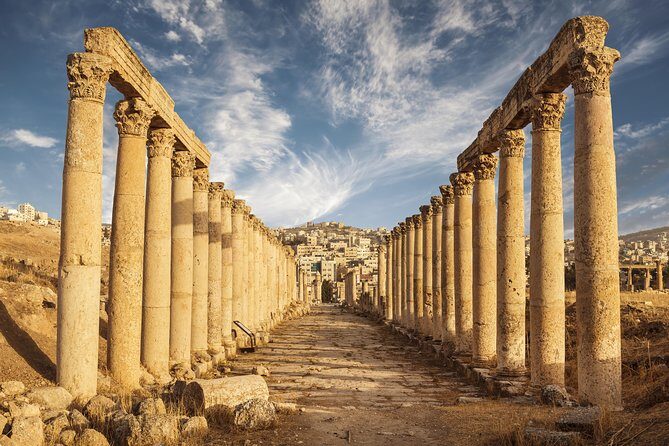
- The Oval Plaza, the egg-shaped forum framed by standing columns, where city life and ceremony would have centered.
- The colonnaded street area associated with Jerash’s main thoroughfare, which helps you understand the city’s scale.
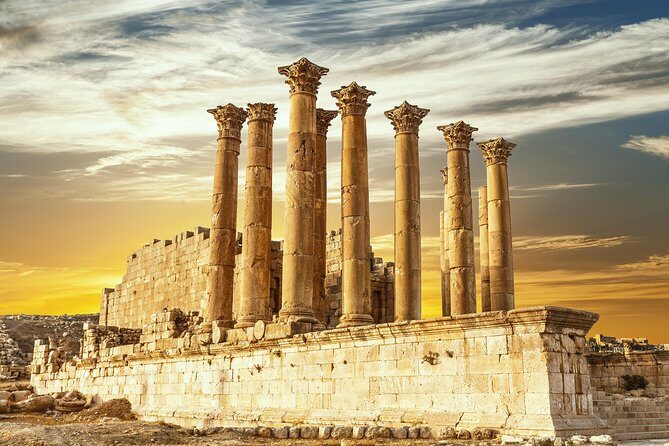
- Major temple zones you can recognize from a distance once your guide connects the dots, including the Temples of Zeus and Artemis.
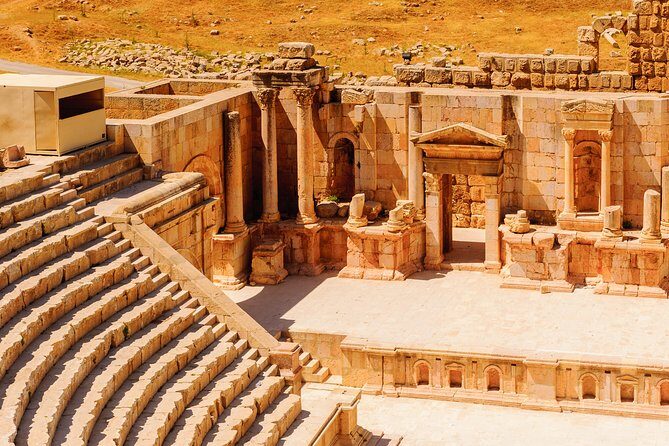
- The entertainment side of Roman Gerasa, including the Hippodrome chariot-racing arena and the Roman Theater presence within the complex.
Even if you have seen Roman ruins elsewhere, Jerash has a way of staying readable. The layout makes sense when a guide gives you the storyline. You see how the ancient builders put people in motion—entry, ceremony, procession on the main street, then performance and public gatherings.
The practical upside of guided time
Jerash is included with about two hours for your main guided visit, plus another hour around the Oval Plaza highlights. That matters because the terrain is spread out. A guide helps you spend that walking time efficiently instead of “slow scrolling” for your next landmark.
It also explains why Jerash gets strong praise when it’s done well. When the guide clicks with your group, the ruins stop looking like random columns and start looking like a functioning city.
Umm Qais (Gadara): hillside ruins, Ottoman village remnants, and a museum you’ll like
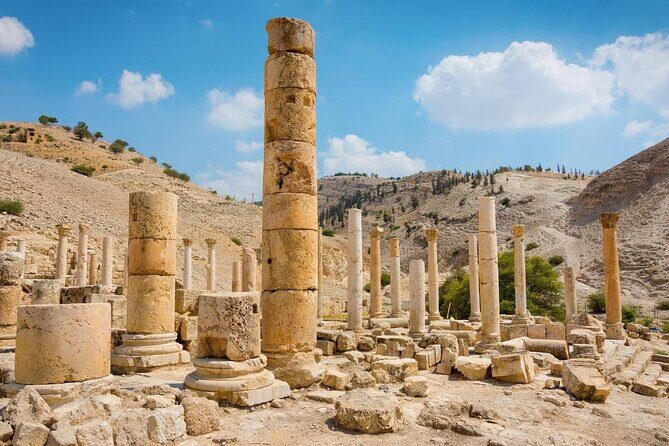
After Jerash, the tour shifts to Umm Qais, near the ancient city known as Gadara. This is where the day becomes more about atmosphere and views as much as architecture.
You head north from Amman by private vehicle and reach the hillside area where Greco-Roman remains sit close to an abandoned, 19th-century Ottoman village. That mix changes the feel of the site. It is not just about Roman stones; it is about how people have occupied the same geography across centuries.
A few more Amman tours and experiences worth a look

The views are part of the value
From Umm Qais, you get expansive sightlines over the Jordan Valley, Sea of Galilee, and Golan Heights. If you like photographing ruins in context, this is a big reason to come. The setting helps you picture why these cities mattered: control points, visibility, and travel routes in the Roman frontier world.
What you’ll actually visit at Umm Qais
You’ll have time to explore the Greco-Roman ruins, including:
- an amphitheater
- a crumbled mausoleum
- a basilica terrace
- additional theaters and remnants across the hillside
Then you visit the on-site museum housed in a restored Ottoman governor’s palace. That museum angle is a smart inclusion. It helps you understand what you are looking at outside, and it breaks the day up so you are not only baking in direct sun.
One note about guides here
A local guide is not included for Umm Qais. Your driver can assist with hiring one if local guides are available, and you’d handle payment directly in destination. If you are the type who likes narrative context, consider planning to read museum captions and ask your driver for a few key orientation points before you start walking.
Pella: the 8,000-year layers stop, with less structure than Jerash
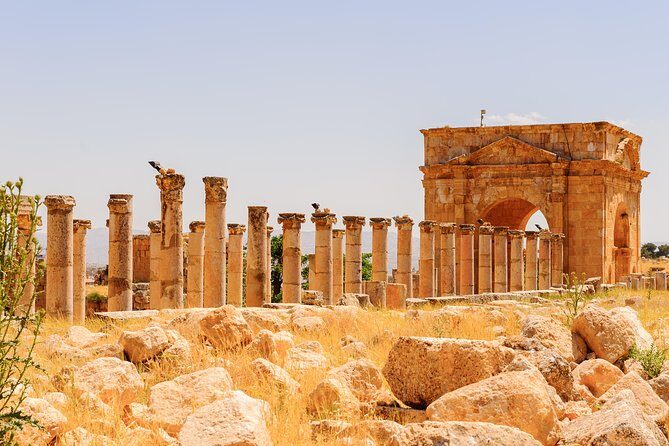
Pella is the far-older piece of the triangle, and it feels different from the moment you arrive. You are visiting the remains of a Hellenistic city, with earlier and later settlements in the same area.
The timeline given for Pella is a big part of the attraction. The site is referenced by Egyptians in the 19th century BC as Pihilum or Pehel, and it later prospered when the Romans arrived. Under Roman influence, you see temples, theaters, and baths.
What you’ll see (and what you might miss)
At Pella, you’ll have about three hours to explore the antiquities, including parts dating back more than 8,000 years. The stop is included with entrance fees, but there is an important practical detail: there is no local guide at Pella included.
That changes how you get value from the time. If you enjoy wandering and making connections between what you see and what you already know, Pella can be rewarding. If you want a guided walkthrough like Jerash, you may feel the structure is lighter.
The real-world risk
One downside worth being honest about: if the site is closed or limited on the day you go, the Pella portion can shrink fast because you are already on the road. In that scenario, Jerash still saves the day, but you might end up spending more time driving than exploring.
The drive, the pacing, and how to avoid a sunburned brain
This is a 10-hour day that starts around 9:00 am. The itinerary is designed with one guided stop that sets context (Jerash), one stop with a museum and self-exploration time (Umm Qais), and one last stop that is more open-ended (Pella).
Private transportation is a serious comfort upgrade here. Public buses between ruins often turn “a day trip” into a series of waiting and reshuffling. With private transfer, you are not timing the day around schedules you cannot control. You also get on-board Wi‑Fi, which is handy when you want to refresh yourself on floor plans or translate site signage on the fly.
You’ll still be doing a lot of walking across uneven terrain. Plan for it. Bring hats and sunscreen, and wear comfortable walking shoes. This kind of day is the easiest way to overestimate how fast you can move in heat.
Price and value: what $160 covers (and what you should budget for)
At $160 per person, the key value is that the price covers real “cost drivers” for a day like this:
- Hotel pickup and drop-off in Amman
- Private air-conditioned vehicle for your group
- English-speaking driver
- Local English-speaking guide at Jerash
- Entrance fees for Jerash and Pella ruins and for Umm Qais and its museum (unless you are handling reimbursement through a Jordan Pass arrangement)
- Wi‑Fi on board
That is why this works better than piecing together three separate visits. You are paying for a coordinated day with the biggest guided component placed where it matters most.
What is not included is also important:
- meals and drinks (unless you add the lunch option, vegetarian by request)
- tips to the driver and local guide (recommended)
- any extra guide hiring at Umm Qais if you want that storytelling layer there
If you want a smoother day, I suggest planning a simple lunch strategy. Restaurants can be dry in many cases, so if you want alcohol, confirm ahead of time. Even with lunch, you may still want a snack or water since the ruins are spread across multiple stops.
Who this tour fits best
This private day trip is a strong match if you:
- want top Roman sites without doing the driving yourself
- like having a guide at least for the main anchor site (Jerash)
- prefer hotel pickup over arranging taxis in a tight schedule
- are okay with one stop (Pella) being more self-directed
It is less perfect if you only want heavily guided ruins at every stop. Umm Qais and Pella do not include local guides as part of the package, so you will rely more on your own curiosity and what the museum and signage can tell you.
If you are traveling as a couple or small group, the private format usually feels efficient. If you are coming with a group, there may also be group discounts available depending on how the operator prices your booking.
Should you book the Jerash, Umm Qais, and Pella private trip?
I think you should book this tour if Jerash is your priority and you want the other two sites to make the day feel full. Jerash with a local guide turns the ruins into a story you can follow, and the Umm Qais museum + views add variety that keeps the day from feeling repetitive.
I would hesitate only if Pella is your must-see stop. Pella is more self-guided, and real-world site conditions can affect how much you actually get to explore. In that case, you might consider a plan where Jerash is the guarantee and Pella is the bonus.
If you do book, go in with the right mindset: this is a high-energy classics day. Bring sun protection, comfortable shoes, and a willingness to slow down just enough at the museum and plazas to absorb what you are seeing.
FAQ
What time does the tour start?
The tour starts at 9:00 am.
How long does the full-day trip take?
It runs about 10 hours (approx.).
Do I get hotel pickup and drop-off in Amman?
Yes. The tour includes hotel pickup and drop-off in Amman.
Is this a private tour?
Yes. It’s private, and only your group participates.
Are entrance fees included?
Yes, entrance fees are included for Jerash and Pella ruins, and for Umm Qais and its museum, if you do not select the Jordan Pass option. If you have Jordan Pass and bought this tour activity with entrance fees, you should inform the operator to reimburse the entrance fees.
Do I get a local guide for all three sites?
A local English-speaking guide is included for Jerash. Local guides at Umm Qais are not included, and Pella has no local guides included.
Are meals included?
Meals are not included unless you choose an option with lunch. A vegetarian meal is available by request.
What languages are available for the tour?
The tour activity is provided in English. Other languages may be available by request (availability is mentioned for Spanish-French at Jerash).
Is Wi‑Fi provided?
Yes. There is on-board Wi‑Fi.
What if the weather is bad or I need to cancel?
There is free cancellation up to 24 hours in advance for a full refund. The experience requires good weather, and if it’s canceled due to poor weather, you’ll be offered a different date or a full refund.