REVIEW · AMMAN
Private Tour: Full-Day Islamic Desert Castles and Ajloun Castle Trip from Amman
Book on Viator →Operated by Zaid Tours and Travel · Bookable on Viator
Desert castles, from frescoes to fortresses, are the point. I like how the day spotlights Quseir Amra frescoes and ends with Ajloun’s hilltop views from a real defensive stronghold. It is a private, air-conditioned day trip that connects the dots between Umayyad desert life and Crusader-era fortification.
The main drawback is simple: it is a long day. You will spend hours in the car on rugged roads, and some stops are more ruins-and-walls than big-ticket “fully intact” castles, so good shoes and patience help.
In This Review
- Key highlights you’ll actually care about
- Why this desert-castles route works so well from Amman
- Getting started in Amman: 9:00 am departure and a long, smooth day
- Quseir Amra (Quseir Amrā): the zodiac dome and why the paintings matter
- Kharanah (Qasr al-Kharanah / Qasr Al-Harranah): early Islamic architecture with Roman-era hints
- Al-Azraq (Qsar Al-Azraq): black basalt walls and the Lawrence of Arabia connection
- Ajloun Castle (Qala’at ar-Rabad): Saladin-era defense and Jordan Valley views from towers
- Transport, Wi‑Fi, and comfort: how to survive 10 hours without losing your mind
- Price and value: what $126.67 buys you on this long day
- Who should book this private castles and Ajloun day trip
- Should you book it? My honest call
- FAQ
- What time does this tour start?
- How long is the tour?
- Is hotel pickup and drop-off included?
- Which sites have entrance fees included?
- Does the tour include Wi‑Fi?
- Are meals included?
- Is this tour private?
- What language is the tour in?
- What should I bring for the day?
Key highlights you’ll actually care about
- Hotel pickup, drop-off, and a/c private vehicle make this drive-heavy day manageable
- Quseir Amra’s interior frescoes include the famous zodiac on the domed ceiling
- Lawrence of Arabia’s ties to Al-Azraq add a modern layer to an ancient site
- Ajloun’s defense details like murder holes plus wide Jordan Valley tower views
- English-speaking driver-guides (for example Mazen, Hasan, and Amer) tend to set a calm, respectful pace
Why this desert-castles route works so well from Amman
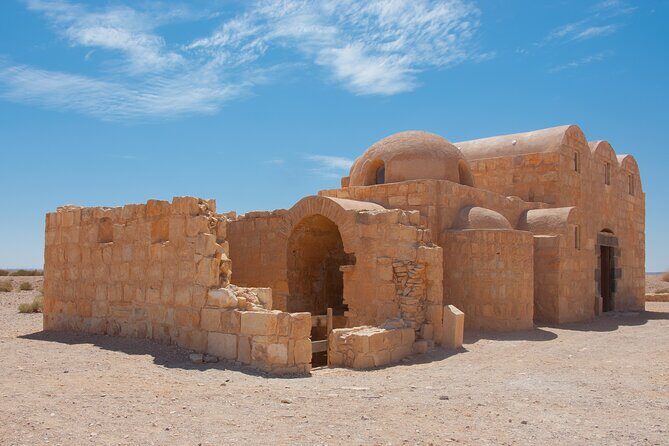
This trip is built around a smart idea: swap the usual only-Amman itinerary for a full-day circuit of eastern Jordan’s Islamic desert sites. You are not just “passing by monuments.” You are moving through the same broad region where Umayyad rulers built rural retreats, hunting lodges, and fortified palaces—then finishing with Ajloun, a later fortress meant for war.
The value here is the combination. You get private transportation, hotel pickup and drop-off, entrance fees for multiple key sites (depending on your Jordan Pass choice), and an English driver who also guides as you go. That matters because these places reward context. A wall painting, an arch, or a domed room makes more sense when someone explains what you’re looking at and why it was built.
And because it is private, you are not stuck with a rigid group rhythm. If you want extra time at one stop, you can usually ask your driver-guide to adjust what you can. In practice, that tends to feel less rushed, especially on a day that can run close to 10 hours.
You can also read our reviews of more private tours in Amman

Getting started in Amman: 9:00 am departure and a long, smooth day
The tour typically starts at 9:00 am. You’ll get picked up from central Amman in a private, air-conditioned vehicle. The day is paced with a mix of driving and set time blocks at each site, including longer time at Ajloun later in the day.
What I like about the pacing is that it gives you breathing room. You are not forced to sprint between stops. You can also use the drive time well: the region is known for multiple castles in a relatively tight area, and your English-speaking driver-guide can share background on Umayyad rule and desert life as you travel.
One practical note: expect a day with real sun exposure. Bring your hat and sunscreen, and wear comfortable walking shoes. These sites involve uneven stone, steps, and corridors in places—especially at Ajloun where you’ll want to climb and look out from towers.
Quseir Amra (Quseir Amrā): the zodiac dome and why the paintings matter
Quseir Amra is the UNESCO-listed stop that usually leaves the biggest impression. It is often described as a hunting palace, but what makes it special is what survived inside: fresco-painted rooms and the striking domed ceiling artwork.
Plan on about 1.5 hours here. The building is restored, and the interior frescoes are what you’re really there for. You’ll see faded-but-stunning wall paintings, including scenes associated with decadence—dinner-party vibes, music or celebration themes, and stylized figures. The domed ceiling is also a highlight, with the zodiac painting that turns the space into more than a fortress. It becomes a statement of taste, education, and imagination from an era when desert life still had court culture.
A small thing that changes your experience: take a minute before you start walking room to room. Stand where you can see how the dome and walls relate, then focus on details. The art is not all “one big famous image.” It is a full interior system.
If you’re the kind of person who likes interpreting symbols rather than just photographing stones, this stop will feel worth the effort. If you only want high-wows, it may help to know that the power of Quseir Amra is interior rather than exterior drama.
Kharanah (Qasr al-Kharanah / Qasr Al-Harranah): early Islamic architecture with Roman-era hints
Next comes Kharanah, often listed alongside Qasr al-Harranah. What you get is a very different feel from Quseir Amra. Instead of a famous painted interior, this stop is about architecture and layout—a fortress-like structure with multiple levels and an arrangement that centers on open space.
You’re given about 1.5 hours here, which is enough time to walk the rooms and courtyard areas without rushing. The setting is described as a plain and the fortress is visually striking in its simplicity: square, with rounded turrets and a central courtyard. Around that core, you can see how rooms and passageways relate.
The background details you’re likely to hear from your driver-guide matter too. The site is thought to have connections to earlier Roman foundations, and the architectural influences are said to reflect a mix—Mesopotamian, Arabic, and Greek touches. Even if you’re not a scholar, it helps to know that early Islamic desert sites often reused ideas from the empires and trade worlds that came before.
What I’d watch for during your visit:
- ornamental pilasters and niches along the courtyard-facing areas
- the way the building’s structure supports use as a fortress, meeting place, or caravanserai (a resting stop for travelers or officials)
This can feel a bit “architectural detective” in a good way. But if your travel style is mostly exterior photos and dramatic views, this stop may not hit as hard as Quseir Amra or Ajloun.
Al-Azraq (Qsar Al-Azraq): black basalt walls and the Lawrence of Arabia connection
Al-Azraq is one of those stops that works on two levels: ancient Umayyad desert design, and a modern story that still hooks people today. Your day hits the fortress about 1.5 hours into the stretch after Amman driving.
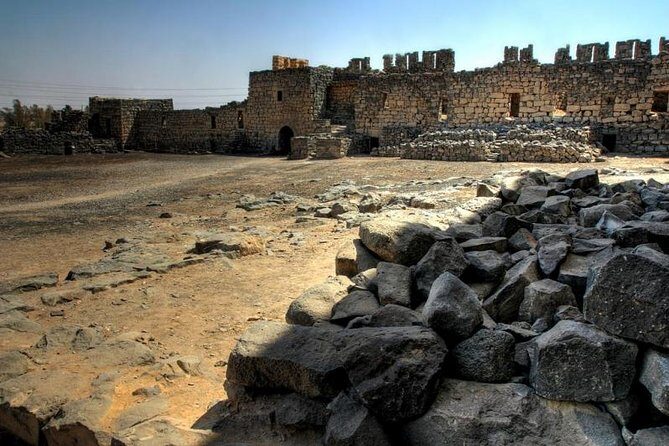
Al-Azraq is built from black basalt rock in the Al-Azraq oasis area. That rock choice gives the site a darker, more serious presence than pale stone ruins. You’ll see courtyards, towers, arches, and a mosque. The context is that it was once an Umayyad hunting retreat, and later—this is the famous connection—it served as a headquarters used by T.E. Lawrence during 1917 to 1918.
The best way to get something from Al-Azraq is to slow down for ten minutes. Look at how the courtyards and towers connect, then imagine the flow of people moving through the spaces. In a desert fortress, movement and sightlines are part of the design. Your driver-guide can also explain how Lawrence based operations here, which turns the visit into more than “cool ruins.”
You may find Al-Azraq less “painted” and more “structured,” which is exactly why it’s a good pairing after Quseir Amra. One stop teaches you visual culture; the next teaches you strategic desert design.
A few more Amman tours and experiences worth a look

Ajloun Castle (Qala’at ar-Rabad): Saladin-era defense and Jordan Valley views from towers
Ajloun is the final major stop, and it deserves its place as the slow stop on the day. You’ll have about 4 hours there, which is rare on day trips. That time buffer helps because Ajloun is active in a physical way: stairs, corridors, and viewpoints.
Ajloun Castle dates to the 12th century and was built in the time of Saladin to defend against Crusader armies. This is not just a scenic hilltop. It’s a fortress made for war, so pay attention to defense features as you walk.
Two things you should actively seek out:
- murder holes, the openings used so defenders could attack invaders from above
- the tower viewpoints where you can see over the hills and toward the Jordan Valley area
The corridors here can feel rambling, and that’s part of the experience. You are walking through the logic of a fort: restricted movement, controlled sightlines, and rooms that support defense and storage. If you like medieval military design, Ajloun is the payoff stop.
Also, plan to climb a bit. The tower views are part of what you’re paying attention for late in the day, and you’ll feel satisfied doing it with real time, not a 20-minute dash.
Transport, Wi‑Fi, and comfort: how to survive 10 hours without losing your mind
This is a private tour, so your day depends heavily on the driving experience and the guidance quality. One advantage of this format is the small gestures that make long days better. In past service on this route, guides such as Mazen, Hasan, and Amer have been described as punctual and patient, and some have even offered water, fruits, or tea at breaks.
On the practical side, the vehicle includes:
- on-board Wi‑Fi
- an air-conditioned private transfer
- an English-speaking driver-guide
Even with all that, you’ll still want your own essentials. Bring a hat, sunscreen, and water if you tend to get thirsty in the sun. The tour does not state that it includes beverages, and meals are not automatic unless you pick an option that includes lunch.
If you’re sensitive to heat, do not rely on shade at every stop. Desert castles are open-air for parts of the experience. Good walking shoes and lightweight layers help you keep moving comfortably.
Price and value: what $126.67 buys you on this long day
At $126.67 per person, the pricing only makes sense if you treat the day as a package: private transport plus multiple entrance fees plus English guidance.
Here’s what you’re generally getting:
- hotel pickup and drop-off in Amman
- private air-conditioned vehicle for the day
- English-speaking driver-guide
- entrance fees for Al-Azraq, Amra (Quseir Amra), and Al-Kharanah and entrance to Ajloun, unless you select a Jordan Pass-related option
- on-board Wi‑Fi
If you are not using a Jordan Pass, the entrance fees being included for several sites is a big part of the value. If you do have a Jordan Pass, the operator notes that entrance fees can be reimbursed in destination for the activity portions that normally include entrance fees.
So, what’s the real trade-off? You are paying for convenience. You could DIY part of this route, but you would lose the calm private pacing and you would need to manage driving, parking, and interpretation yourself. For most people, that trade-off is worth it on a 10-hour day.
Who should book this private castles and Ajloun day trip
This tour fits best if you:
- want to see Islamic-era desert sites in one efficient circuit
- enjoy architecture and interior details like frescoes
- like history that connects rulers, desert living, and military defense
- prefer a private format over group logistics
It can be less satisfying if you expect every stop to feel like a fully “intact” castle experience. Several are described as castles or fortresses, but they function more like palaces, fortified ruins, and defensive complexes. Think in terms of rooms, courtyards, defensive openings, and walls—then let the story do its work.
If you travel solo, the private vehicle and respectful guide approach can matter a lot. On this route, guides have been described as especially gentlemanly and attentive, with a tone that helps people feel at ease.
If you have mobility concerns, you’ll need to contact the operator. The tour notes that clients with mobility issues should reach out, because stairs and uneven stone are part of these sites, especially at Ajloun.
Should you book it? My honest call
Book this tour if you want a day that feels like a guided lesson in eastern Jordan, not a checklist. The mix of Quseir Amra’s painted interior, Al-Azraq’s basalt fortress with Lawrence of Arabia ties, and Ajloun’s defensive stronghold is a smart combination. You’ll also appreciate the private pacing, the air-conditioned vehicle, and enough time at the big finale.
Skip it or pair it with something else if your idea of a great day is mostly modern comforts and dramatic views at every stop. This is a sun-and-stone day with long driving time. Come ready for that rhythm, and you’ll get a satisfying snapshot of Jordan far beyond the usual highlights.
FAQ
What time does this tour start?
The tour starts at 9:00 am.
How long is the tour?
It runs for about 10 hours (approx.).
Is hotel pickup and drop-off included?
Yes. Hotel pickup and drop-off in Amman are included.
Which sites have entrance fees included?
Entrance fees are included for Al-Azraq, Amra, and Al-Kharanah and for Ajloun Castle, as long as you did not select the Jordan Pass option that changes entrance fee handling.
Does the tour include Wi‑Fi?
Yes. There is on-board Wi‑Fi.
Are meals included?
Meals are not included unless you choose an option with lunch (vegetarian meal by request).
Is this tour private?
Yes. It is private, and only your group participates.
What language is the tour in?
The activity is provided in English. Other languages are available by request.
What should I bring for the day?
Bring hats, sun screen, and comfortable walking shoes. The day includes walking at multiple sites in sun-exposed areas.