REVIEW · SWEIMAH
Jerusalem & Bethlehem Full-Day Tour from Amman or Dead Sea
Book on Viator →Operated by VIP Jordan Limo · Bookable on Viator
Jerusalem and Bethlehem in one long day can work. This full-day trip from Amman (or the Dead Sea area) strings together classic air-conditioned ride time, English-speaking driver support, and the big holy landmarks—Mount of Olives, the Old City through Zion Gate, and Bethlehem’s Church of the Nativity.
I love the Mount of Olives panoramas and how you get a high, readable view of Jerusalem before you head into the Old City lanes. I also like the practical touches: free Wi‑Fi and mineral water on board help the day feel less rushed.
The main catch is border timing. Waiting time at the border is capped at 60 free minutes, then it costs $49 for an extra hour or part of an hour, and the day can involve vehicle handoffs around the crossing.
In This Review
- Key things to know before you go
- A private day from Amman: what the schedule really feels like
- Border crossing and why the permit paperwork matters
- Mount of Olives: first views, then the sacred sites overhead
- Temple Mount: the Dome of the Rock from the center of the world
- Old City through Zion Gate: Western Wall to the Via Dolorosa corridor
- Church of the Holy Sepulchre: the ending point of the pilgrimage
- Tower of David and Mount Zion: short stops with serious names
- Old City ramparts: a walk that gives you your bearings
- Bethlehem: the Church of the Nativity and the underground birth grotto
- Price and value at $559.99 per person
- Who this tour fits (and who should think twice)
- Should you book this Jerusalem and Bethlehem full-day tour?
- FAQ
- How long is the Jerusalem and Bethlehem tour?
- Does the tour include pickup from Amman or the Dead Sea area?
- Is an English-speaking driver included?
- Are admission tickets included for the main sites?
- Is there a waiting-time cost at the border?
- What document do I need to send, and how?
- Can I get a refund if I cancel?
Key things to know before you go
- Private, air-conditioned transport with an English-speaking driver and free Wi‑Fi
- Mount of Olives top views from the Church of the Ascension (built in 1910)
- Old City entry via Zion Gate, then a route that hits Western Wall, Via Dolorosa, and the Holy Sepulchre
- A Friday-only option to join the Via Dolorosa procession led by Italian Franciscan monks
- Tower of David for a quick hit of Herodian-era history and the Jerusalem story in the museum
- Passport paperwork for the Allenby Border Crossing permit sent by WhatsApp after booking
A private day from Amman: what the schedule really feels like
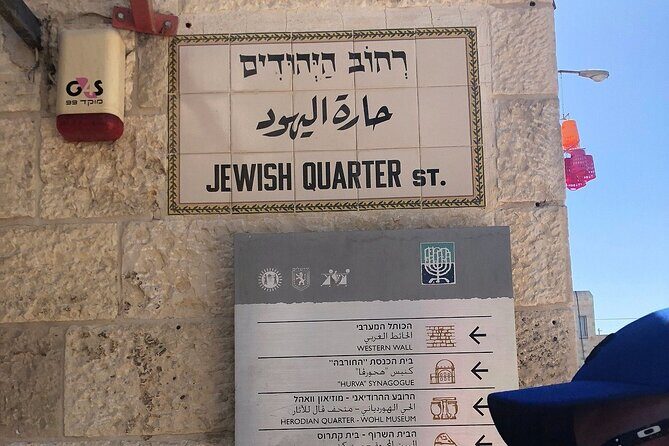
This tour is built for people who want the highlights without trying to stitch together buses, taxis, and timing puzzles on their own. You’re out for about 11 to 12 hours, with a modern air-conditioned vehicle and an English-speaking driver keeping the day organized.
The best way to think about the pacing is this: you’re stacking multiple “must-see” sites in one ribbon of time. Some stops feel like a true visit (like the Old City and Bethlehem), while others are quick drops where you get the main sight and move on. For example, the itinerary gives time blocks that range from about 5 minutes at the Tower of David to around 1 hour for several Old Jerusalem stops, then about 2 hours in Bethlehem.
That structure can be great if your goal is breadth. If your goal is deep study and long museum time, you’ll likely wish you had more hours. It’s also why the “driver who speaks English” part matters. When you’re moving through places with strict routes and different faith traditions side-by-side, having a driver who can guide you clearly is a real value.
You can also read our reviews of more tours and experiences in Sweimah.

Border crossing and why the permit paperwork matters
This is not a simple “show up and go” day. You’ll need a passport photocopy sent after booking via WhatsApp so the operator can obtain a permit for Allenby Border Crossing. If you’re slow to send that, you can’t count on the day going smoothly.
Another practical point: there’s an explicit waiting window at the border. The tour includes 60 minutes of waiting, then you pay $49 for an extra hour (or part of an hour). That doesn’t mean border delays are your fault, but it does mean you should plan for a schedule that can stretch.
Also, read your expectations carefully. One piece of feedback I’d pay attention to is that some days involve more than one driver and a crossing moment where you might switch from car to a shuttle-style step. If you don’t like handoffs, this may feel slightly awkward mid-day. Still, you’re paying for private transport and English-speaking guidance, so the trade-off is worth weighing: fewer planning headaches, but a day that can feel segmented around the crossing.
Mount of Olives: first views, then the sacred sites overhead
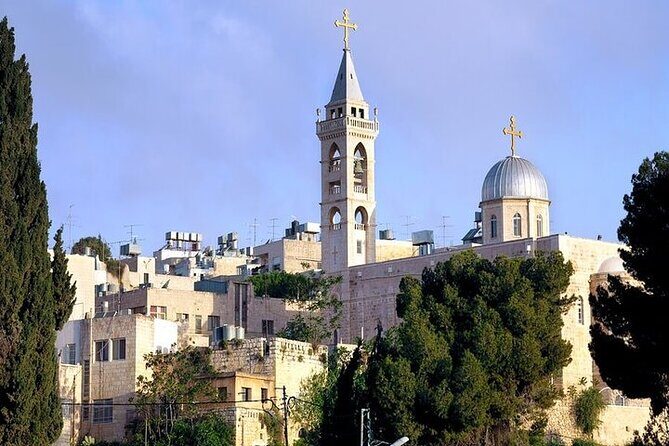
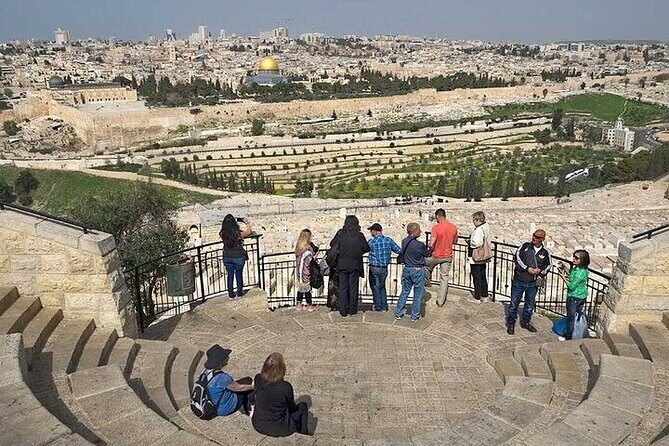
The day starts on Mount of Olives, and it’s a smart move. You’re high up early, so Jerusalem looks like a city instead of a maze. You get the “from above” feeling before you’re surrounded by narrow streets.
You’ll stop with views across the Old City, including the Church of the Ascension. The itinerary notes this church dates to 1910, and the location is famous for the viewpoint it offers. From there, walking downhill takes you toward the Church of the Pater Noster, traditionally associated with the place where Jesus instructed his disciples.
What I like here for first-timers is that the Mount of Olives doesn’t ask you to pick a single story. Even if you’re not religious, you can still appreciate that this hill is linked to major traditions: resurrection at Judgment Day (as Christian belief holds), and Jesus’ ascent to heaven after the crucifixion and resurrection. It gives context for why pilgrims come here again and again.
One caution: this is a lot of spiritual meaning packed into a short stop. If you prefer a slower, reflective pace, treat this as your orientation stop. Your “long think” time will mostly come later in the Old City routes.
Temple Mount: the Dome of the Rock from the center of the world
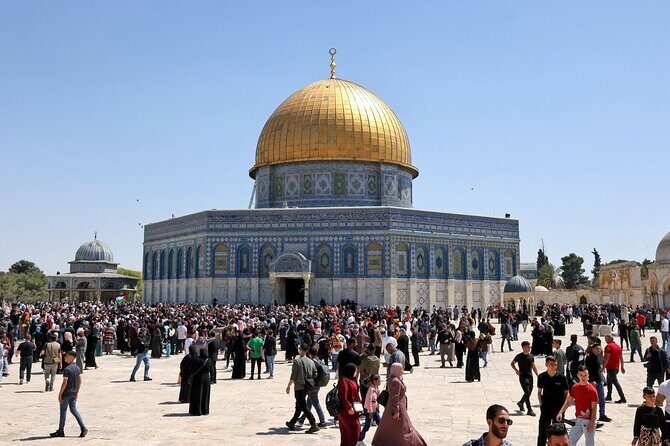
Next is the Temple Mount area (also known as Haram Al-Sharif in the text). This is one of the places where you feel how layered the land is—Jews, Muslims, and Christians all connect history and belief to this specific ground.
The tour’s description places the story of Abraham here, including the account of offering his son. It also references Solomon building the First Temple for the Ark of the Covenant, and mentions the Prophet Muhammad’s ascent to heaven during early preaching.
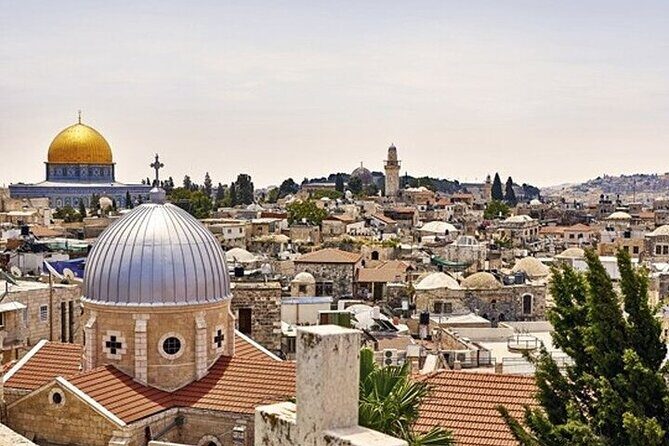
Your practical takeaway is the skyline view. The itinerary highlights the plaza above the Old City centered around the Dome of the Rock, which is Jerusalem’s most iconic landmark. Below the dome, the tour mentions the sacred stone believed by Jews and Muslims to be the place where Abraham offered the sacrifice.
I’d consider this stop more of a “big-picture” moment than a detailed one. The time is about 1 hour, and with a site this politically and spiritually charged, your job is to be flexible and let the setting do the talking.
Old City through Zion Gate: Western Wall to the Via Dolorosa corridor
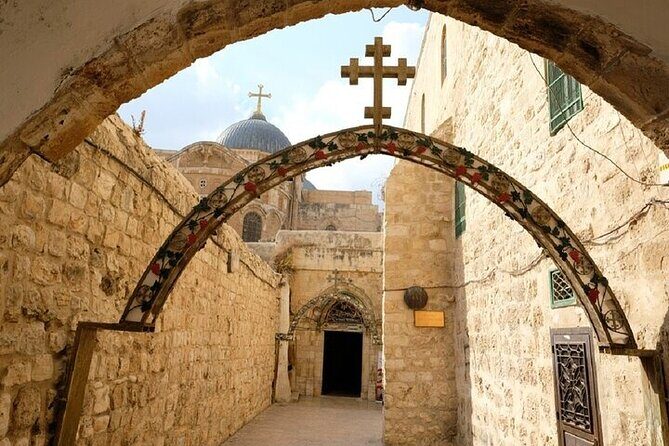
Once you enter the Old City through Zion Gate, the trip shifts from scenic viewing to walking routes. This is where the day starts to feel real—stone, arches, signs in different alphabets, and the sense that you’re stepping into centuries of movement.
The itinerary routes you toward the Western Wall (Wailing Wall) area, then into the older pilgrimage path: Via Dolorosa. The Via Dolorosa portion is about following the route Jesus took after condemnation, bearing the cross toward execution at Calvary. The guide value here isn’t only the story. It’s that the route is marked with the fourteen Stations of the Cross, some tied to Gospel accounts and some based on tradition.
If your visit lines up with a Friday, the tour notes you can join the procession led by Italian Franciscan monks along the route. If not, you can still follow the path independently because it’s laid out as a street-by-street walk from the first station area toward the Church of the Holy Sepulchre.
For people who get overwhelmed in crowded religious sites, the Via Dolorosa can be emotionally heavy. It’s powerful, but it can also be busy. Keep your water with you, wear comfortable shoes, and accept that this walk is part route, part atmosphere.


Church of the Holy Sepulchre: the ending point of the pilgrimage
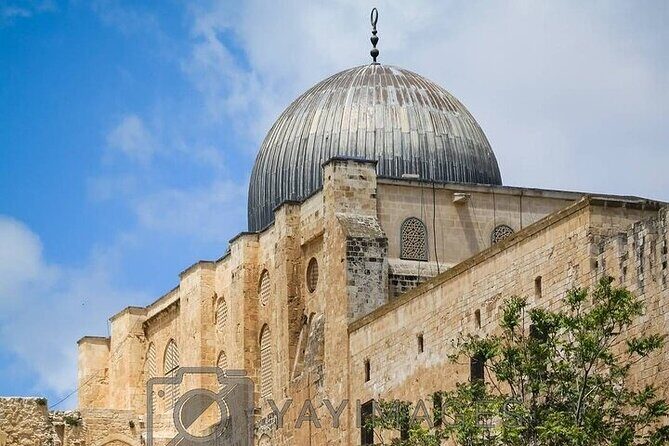
The Church of the Holy Sepulchre is listed as the central Christian pilgrimage stop, and the itinerary gives enough background to make it more than just a dramatic building.
It’s said to be built on the site of Jesus’ crucifixion. The text attributes the selection of the site to Saint Helena, mother of Constantine, and notes she announced the spot as Calvary (Golgotha) to the Byzantine world. The original church is described as being built in 335 CE, destroyed in 1009, and replaced by the grand church you see today from the 11th century.
The church interior is described as opulently beautiful, and the itinerary also points out the practical connection: the Via Dolorosa ends here, and the last five Stations of the Cross are within the church.
This stop can be a highlight, but it’s also one of the places where you may feel “everyone is here at once.” You’ll likely want to take a slow look first, then step back and reset your bearings so you don’t miss key parts while moving through the flow.
Tower of David and Mount Zion: short stops with serious names
Two more stops balance the day out: Tower of David and Mount Zion.
Tower of David (the citadel) is explained as being tied to Herod, not King David. The text says Herod built it to protect the palace around 24 BCE, with towers named after Phasael, Mariamne, and Hippicus. After Titus’ conquest in 70 CE, the Romans stationed a garrison there. Later, it was rebuilt over time by the Crusaders, Mamelukes, and Ottomans. The building you see today is described as 14th century, on foundations of the original Phasael Tower.
Inside is the Tower of David Museum, focused on the story of Jerusalem with permanent archaeological exhibits. The itinerary lists only 5 minutes here, so in real life this is more of a photo-and-overview moment than a museum deep dive.
Then you head to Mount Zion, just south of Zion Gate, where Jewish and Muslim shrines and churches sit close together. The itinerary notes that Mount Zion is revered as the place of the Last Supper (with tradition tying Mary’s final years here as well, though another tradition places her final days in Ephesus). For Jews, the importance includes King David’s Tomb.
Climbing the stairs from the tomb courtyard brings you to the Last Supper Room, described as serving as both church and mosque. Nearby are the Church of the Dormition and the Church of St. Peter of Gallicantu, where Peter is said to have denied Jesus.
Mount Zion is a good “wrap” for your Jerusalem phase because it connects the Old City’s stones to New Testament moments without needing to cram in more routes.
Old City ramparts: a walk that gives you your bearings
The itinerary includes time to experience the Old City fortifications from the ramparts. The fortifications are described as Ottoman-period, with nine gates that lead into the Old City.
You’ll find several gates referenced by name. The tour points out Damascus Gate, Lion’s Gate (also called St. Stephen’s Gate), Zion Gate as the main entrance into the Jewish Quarter, and Jaffa Gate as the main passageway for the Christian Quarter.
Walking the wall ramparts is a strong way to break the day into something physical but not mentally exhausting. The itinerary notes two walk options: Jaffa Gate north to Lion’s Gate, or Jaffa Gate south to Dung Gate. Even if you only cover part of a section, you’ll get a better “map in your head” for the sites you just visited.
This is also where the value of having a driver matters again. If you get delayed in one area, you want a plan that still gets you onto the wall walk and into Bethlehem with time to spare.
Bethlehem: the Church of the Nativity and the underground birth grotto
After Jerusalem, you travel to Bethlehem, about 10 km (6.2 miles) south. The town name is given as beit lechem, meaning House of Bread in Hebrew.
Bethlehem is described as a pilgrimage destination especially during Christmas season for the Church of the Nativity, where the exact place of Jesus’ birth is marked in an underground grotto. That underground element is a big reason this stop feels different from all the “above-ground” churches you’ll see in Jerusalem. You’re not just looking at architecture. You’re encountering a specific spot tied to the birth narrative.
The itinerary also includes Rachel’s Tomb at the northern entrance of Bethlehem and notes it’s an important Jewish holy site. For the Old Testament angle, the text references Bethlehem as David’s home city and where he was crowned first king of Israel.
The Bethlehem stop is listed for about 2 hours, and it’s marked with admission ticket free for this segment. That doesn’t necessarily mean everything inside the church is free, but it does mean your time here is less likely to be squeezed by extra ticket costs than some of the Jerusalem stops.
Price and value at $559.99 per person
Let’s talk money plainly. At $559.99 per person, this isn’t a budget day trip. You’re paying for private transport, an English-speaking driver, and the fact that you’re trying to cover Jerusalem and Bethlehem in one push without juggling local transit or timing.
What makes the cost more reasonable is what’s included:
- Private transportation in a modern air-conditioned vehicle
- English-speaking driver
- Free Wi‑Fi and mineral water on board
- Mobile ticket
- Pickup offered, plus notes about group discounts
Where the cost can feel heavy is when you compare it to the amount of time at a few stops. Tower of David gets only about 5 minutes. Several others are around 1 hour, and admission tickets aren’t included for many of those stops. So you should budget for site entry fees even though the tour price covers the transport and driver.
If you value comfort and clear routing more than you value long museum time, this price can make sense. If you’re fine planning on your own and don’t mind the logistics, a cheaper option might exist. Still, for many people, the border permit paperwork plus the organized holy-site route is the real convenience you’re buying.
Who this tour fits (and who should think twice)
This tour fits best if you want:
- a private day with an English-speaking driver,
- the main holy sites in Jerusalem plus Bethlehem in one go,
- and a schedule built around getting from place to place without you solving transit puzzles.
It might not fit as well if you hate tight time blocks. With multiple 1-hour stops and one 5-minute museum moment, you’re not doing slow wandering. You’re following a route.
And if you strongly prefer a single-driver, single-vehicle day, consider the border handoff possibility. One piece of feedback I’d take seriously is that the day may involve several drivers and a shuttle-style crossing step, which can feel less elegant than you’d expect.
Should you book this Jerusalem and Bethlehem full-day tour?
I’d book it if you want a well-packed day, appreciate high-view first impressions from the Mount of Olives, and want a route that connects the Old City’s pilgrimage logic—Zion Gate, Western Wall area, Via Dolorosa, and the Holy Sepulchre—then finishes in Bethlehem at the Church of the Nativity and its underground birth grotto.
Skip it or consider alternatives if your ideal travel day is slow and deeply detailed at one site. This is a great “greatest hits” plan. Just go in with the right mindset: it’s a long day, border timing matters, and you should expect ticket costs at some stops.
FAQ
How long is the Jerusalem and Bethlehem tour?
It runs about 11 to 12 hours.
Does the tour include pickup from Amman or the Dead Sea area?
Yes. Pickup is offered, and you’ll meet the team based on the pickup arrangement.
Is an English-speaking driver included?
Yes. The tour includes an English-speaking driver for the trip.
Are admission tickets included for the main sites?
Not always. The itinerary shows admission ticket not included for several stops (like Mount of Olives, Temple Mount, Church of the Holy Sepulchre, Via Dolorosa, Tower of David, Mount Zion, and the Old City). Bethlehem is marked admission ticket free in the time block shown.
Is there a waiting-time cost at the border?
Yes. The tour notes $49 will be charged for an extra hour or part of an hour after 60 free minutes of waiting at the border.
What document do I need to send, and how?
After booking, you’re asked to send a passport photocopy via WhatsApp so the operator can obtain a permit for Allenby Border Crossing.
Can I get a refund if I cancel?
No. The experience is non-refundable and cannot be changed for any reason.